
Introduction
Steven A. Carlson
2/1/20265 min read
Authorship
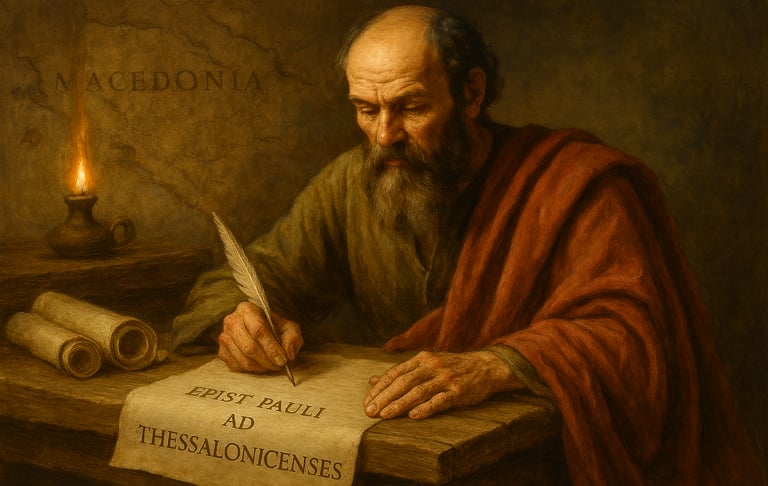
Few would care to question Paul’s authorship of the letters to the Thessalonians. His relationship with the believers of the city of Thessalonica is chronicled by Luke as he documented the apostle’s missionary journeys. According to respected theologian James Moffatt (1870-1944), “It is no longer necessary to discuss the authenticity of 1 Thessalonians or even its integrity.”[1] Ronald A. Ward has attested to Paul’s authorship, stating, “There can be no doubt that Paul wrote the epistle.”[2] Similar comments have been offered by other commentators.
On his second missionary journey, Paul visited the city of Thessalonica and established a local congregation of believers. Unfortunately, his stay was cut short. The city consisted of a relatively strong contingent of Jews as is evident from the fact that they had a synagogue in Thessalonica. However, there was also a large population of pagans in the city. Thessalonica was located just north of Mount Olympus, the purported home of sundry mythical Greek gods, so paganism ran rampant.
It is unknown exactly how long Paul remained in Thessalonica, but trouble began shortly after he arrived. First the Jews, who held to their strong traditional Mosaic views and claimed he was challenging Caesar’s authority (an obvious ruse), rose up against Paul and his companions. Still, Paul was there long enough to make some converts and help establish a local congregation of believers.
Context
Date – There is general agreement among a great number of Bible scholars that the book of 1 Thessalonians may have been Paul’s first canonized epistle. Some believe it is possible that Galatians may have been written earlier (no earlier than AD 48), but available evidence seems to suggest a later date. The timeline is such that many think Thessalonians was penned just a few short months after the apostle left Thessalonica. Assuming Paul exited the city sometime around August of AD 49, and allowing for the spacing of events between that exodus and the writing of the letter, it is likely that Paul wrote this first letter to the Thessalonians in the spring of the year AD 50.
Place – Paul and Silas were not forced to leave Thessalonica, per se. However, when the persecution of the new believers by the Jews of the city took on a mob-like persona (Acts 17: 5-9), everyone evidently agreed that it would be best if they left the city. Consequently, they traveled to Berea and were well-received in the synagogue…that is, until certain Jewish troublemakers from Thessalonica, having heard of Paul’s success, arrived to challenge him.
In an attempt to avoid too much confrontation, the Bereans escorted Paul to Athens Greece. When they took their leave to return to Berea, Paul asked them to have Timothy and Silas, whom he had left in Berea, join him in Athens (Acts 17: 15). When they arrived, Paul sent Timothy to go and check on the Thessalonians in Macedonia and bring back a report of their status (1 Thessalonians 3: 1-5). It is assumed that Silas either accompanied Timothy or took on a separate errand in Macedonia, perhaps a trip to Philippi, since they returned from Macedonia together. Having experienced a seemingly unfruitful ministry in Athens, Paul left for Corinth, which is where Timothy and Silas caught up with him (Acts 18: 1-5) After receiving a good report from Timothy about the spiritual condition of the believers in Thessalonica (1 Thessalonians 3: 6), Paul sat down and wrote this epistle…from Corinth.
Audience – The letter is written to the believers in Thessalonica, which is located in the province of Macedonia. Paul had ministered there on his second missionary journey and a congregation of believers was established. While Paul alludes to local church leadership (1 Thessalonians 5: 12), no individuals are mentioned in the epistle, so it is safe to say it was intended for general consumption. Indeed, even his mention of the church leaders is not to them, but about them and the fact that the congregation should follow their lead.
The history of Thessalonica is rich, both before and after Paul’s letters. The city was founded in 315 BC by Cassander (358-297 BC), a former general of Alexander the Great, who named the city after his own wife who also happened to be Alexander’s half sister or step-sister. The Romans overtook the city in 167 BC. The city gained favor by supporting Octavius (a.k.a., Augustus Caesar) in the wars that thrust him into power and, as a result, enjoyed freedom from military occupation, a considerable measure of local autonomy, and special tax considerations from Rome. This sort of favorable status, along with its strategic geographical location on the Aegean Sea, soon turned the city into one of the largest and wealthiest in the region.
While the city’s ancient history may have seemed glorious, calamities befell the city over time. For instance, Theodosius (347-395 AD), emperor of Rome, slaughtered 7,000 people in the city when they rose up against the emperor’s military and killed one of his generals in 390 AD. Later, certain Muslims known as Saracens, attacked the city leaving countless bodies behind and capturing several thousand, many of whom they ransomed back to Rome in exchange for the release of Muslim prisoners. The city faced more devastation in the 15th and 19th centuries, to say nothing of the damage done to the city during WWII. Thus, the history of the city is both intriguing and colorful.
Purpose – While Paul was in Thessalonica, a mob invaded the house of a man named Jason in an effort to find Paul and Silas. When they did not find them, they took Jason before the city authorities in an unsuccessful attempt to find some legal ground to stunt what was obviously a growing number of believers in the city (Acts 17: 1-9). On the heels of this incident, Paul and Silas left the city by night, undoubtedly believing these new converts would face less hardship if Paul was gone.
It probably bothered Paul that he had left the city so quickly, especially given the fact that the believers in Thessalonica were truly babes in Christ. He was concerned not only for their well-being, but for their spiritual growth. They had received instruction from the apostle and the OT Scriptures were available, but they probably had little else to help them mature or strengthen their faith. Consequently, Paul sent Timothy to check on them and report back to him (1 Thessalonians 3: 1-5).
Timothy returned to Paul with an exceedingly good report about the status of the Thessalonians (1 Thessalonians 3: 6). They had strengthened in the faith and in love. Still, they faced fierce opposition from the Jews of the city. Consequently, Paul chose to write a letter of support and thanksgiving concerning them. Included in the letter was additional instruction meant to provide them with greater knowledge and to further encourage them in their walk with Christ.
Despite its brevity, the epistle is saturated with practical doctrinal instructions. Included in this letter are teachings concerning the authenticity and authority of the Word of God (2: 13), confirmation that Jehovah is the one true God (1: 9), some instruction concerning the concept of the Godhead as three persons in one (1: 1-6; 4: 8; 5: 19), and the deity of Jesus Christ (3: 11-12). The apostle also touched on atonement through the death of Christ (4: 14; 5: 9-10), the value of discipleship (2: 1-2), and assorted other topics.
________________________
[1] Moffatt, James, The Expositor’s Greek Testament, Vol. iv, Wm. B. Eerdmans Publishing Company, Grand Rapids, MI, 1967, p. 11.
[2] Ward, Ronald A., Commentary on 1 and 2 Thessalonians, Words Book Publishers, Waco, TX, 1973, p. 9.